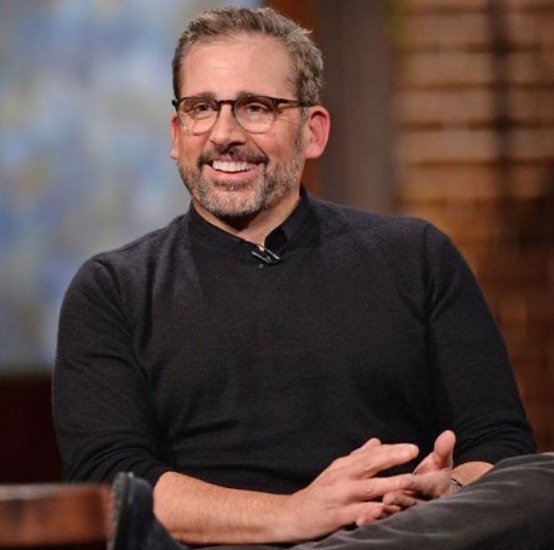
There is a version of Steve Carell’s life where none of this happened. Where he stayed in Concord, Massachusetts, followed a safer path, and never walked into a Chicago improv club in 1984 looking for something he could not quite name yet. That version does not exist, obviously. But it is worth thinking about, because the actual version is strange enough that it almost feels unlikely in retrospect.
View this post on Instagram
Second City is where it actually started
The biography page version says Steve Carell graduated from Denison University in 1984 and moved to Chicago to study improv at Second City. That is accurate, but it undersells the timeline. He was not an overnight success story. He performed and taught at Second City, appeared in five Mainstage revues between 1991 and 1994, and spent years building the kind of instincts you cannot fake and cannot rush.
What almost nobody mentions is the specific crowd he was running with during those years. The Second City roster in the early 1990s was absurdly talented in retrospect. Stephen Colbert was Steve Carell’s understudy at the time. Not a colleague of equal standing. His understudy. Meaning if Carell did not show up, Colbert went on in his place. Amy Poehler came through the same Chicago improv circuit around the same period, training at Second City and iO before heading to New York. Tina Fey was there too. The concentration of people who would go on to define American comedy for the next thirty years, in one city, in roughly the same three-year window, is something nobody has fully explained to my satisfaction.
The Steve Carell and Stephen Colbert connection deepened after Second City. Both ended up on The Dana Carvey Show in 1996, which was cancelled after seven episodes but has since been credited as the show that quietly built both of their careers. They also worked together on The Daily Show starting in 1999, where Carell was a correspondent and the two did a regular segment called “Even Stevphen” in which they were supposed to debate topics and mostly just yelled at each other. It was funnier than it sounds.
Steve Carell age and what 63 looks like in practice
Steve Carell was born on August 16, 1962, which makes him 63 years old as of 2026. This comes up because Rooster puts his age directly into the story. His character, Greg Russo, is described by another character in the show as being “around sixty, and nobody is forcing him to stay.” Which is either a well-placed joke or a bit of self-awareness from the writers, or both.
The honest thing about Steve Carell at this stage of his career is that he has not tried to pretend the years are not there. Greg Russo is not a young man navigating early-adult chaos. He is a bestselling author in his sixties, recently divorced, emotionally adrift, trying to repair a relationship with his daughter while stumbling through a job he never expected to have. The show is built around that specific kind of middle-aged lostness, and it would not work if Carell were twenty years younger. The age is the point.
Steve Carell wife Nancy and a detail most people missed in episode three
Steve Carell and Nancy Carell have been married since 1995. They met at Second City, where she was a student in an improv class he was teaching. Nancy Carell, whose maiden name is Walls, went on to have her own television career, including a year as an SNL cast member in 1995. They have two children, a daughter named Elizabeth born in 2001 and a son named John born in 2004.
The detail that flew past a lot of casual viewers in the Rooster TV show episode three: Nancy Carell appears in the show. She plays Susan, the wife of Dean Riggs. Her scenes are with Steve, set in a hospital room during a late-night vigil while Dean Riggs recovers from a medical event. It is the kind of small casting choice that could have been purely sentimental, but the scenes between Steve and Nancy Carell actually work on their own terms. They share a specific kind of ease that you do not get from actors who have only known each other professionally.
The broader point about Steve Carell wife Nancy as a couple is that they are genuinely unusual in their industry. They met doing comedy, they both kept working, and they have stayed together for thirty years in a profession that does not make that easy. Whatever their formula is, it seems to be holding.
The Rooster TV show explained, for people who have not watched it yet
Rooster premiered on HBO on March 8, 2026. It was created by Bill Lawrence and Matt Tarses. Lawrence is the same person behind Scrubs, Ted Lasso, and Shrinking, which should tell you something about the general emotional register the show is going for.
Steve Carell plays Greg Russo, a bestselling author of beach reads who has never been to college but ends up taking a position as writer-in-residence at the fictional Ludlow College. The reason he takes the job is complicated. His daughter Katie, played by Charly Clive, is a professor there who burned down her cheating husband’s house and punched a faculty member, and Greg strikes a deal with the college administration to keep her employed. In exchange, he starts showing up to teach. Neither of them knows the full picture of why the other one is there, at least not at first.
Danielle Deadwyler plays Dylan Shepherd, the staff member who finds Greg’s presence professionally inconvenient and personally confusing after a rejected pass in the early episodes. Phil Dunster plays Archie, Katie’s terrible husband. John C. McGinley is Walter Mann, the college president. Alan Ruck is Dean Riggs, who ends up in the hospital by episode three and whose absence forces Dylan into an interim role she did not want.
The show holds an 89 percent approval rating on Rotten Tomatoes based on 44 reviews. Metacritic puts it at 67 out of 100. The gap between those two scores is probably the most honest way to describe the show: critics largely find it warm and well-acted, with some finding it too comfortable in its own likability.
What most reviews have missed is this: Rooster is less interested in plot mechanics than in the specific texture of being needed by someone who does not want to need you. Greg signed on to that job for Katie. She does not know that. He cannot tell her without admitting he orchestrated the whole thing. So he sits in this position of privately caring for someone who is publicly indifferent to him, trying to be useful to a place he has no real claim to. That is the emotional engine of the show, and Steve Carell is the right person to run it. He has always been best at playing people who want more connection than they know how to ask for.
What episode three actually does, and why the Nancy Carell casting matters more than it looks
Episode three is titled “White Whale.” Greg’s first full day as a professor does not go well. He references Moby Dick in class and is sent to the dean’s office for allegedly body-shaming a student. He then trips in front of the class and falls into a student in a way that lands him in another disciplinary meeting. The episode runs his attempts at normality into one wall after another.
The subplot that carries more weight is Dean Riggs ending up in the hospital, which forces Dylan into the interim dean position without preparation or enthusiasm. She is now Greg’s de facto supervisor, which layers awkwardly onto everything that has already happened between them. At the hockey game near the end of the episode, Greg tells Dylan he feels alone at Ludlow. She responds that he sounds like a homesick freshman, and that the difference is he is sixty and nobody is making him stay. He tells her that was mean. She does not entirely disagree.
In a conversation with TV Insider, Carell described his character’s relationship with Dylan as one where Greg finds her formidable, wants her friendship, and is also a little intimidated by her. That read comes through on screen. The two of them have a specific kind of friction that does not resolve cleanly in either direction, and the show is smart enough not to rush it.
The Steve Carell and Nancy Carell casting, in this context, lands differently than a standard celebrity cameo. She plays Susan Riggs in the hospital scenes and her only moments are quiet, late-night conversations with Steve’s character. There is an intimacy in those scenes that is hard to manufacture. Whether that is good acting or thirty years of marriage bleeding into the work is probably not a question worth answering. It works either way.
The Second City thread that runs through everything
One of the things that does not get enough attention in the Steve Carell story is how much of his career has stayed connected to the Second City network even decades after he left Chicago.
Amy Poehler, who trained at Second City and iO in the early 1990s before founding the Upright Citizens Brigade, is a frequent point of reference when people discuss the generation of comedians Carell belongs to. She and Tina Fey built something at SNL that had direct roots in the same Chicago improv tradition Carell trained in. The sensibility is recognizable across all of them: character-led, emotionally grounded, more interested in human dynamics than in pure joke construction.
Steve Carell and Stephen Colbert, who started as Carell’s understudy and has since built one of the longest-running late-night franchises currently on television, represent two different branches of the same tree. Carell went toward film and ensemble television. Colbert went toward political satire and the CBS Late Show. They both got there through the same two or three years of Second City Mainstage revues in the early nineties.
What Second City gave all of them, and what Rooster quietly benefits from, is a specific way of playing vulnerability. Second City improv teaches you to find the truth in a character before you find the joke. Greg Russo is funny because he is recognizably human first. That is not a coincidence. It took thirty-odd years to build the muscle that makes that look easy.
What to make of Steve Carell right now
There are actors who peak early and spend the rest of their careers living off the residue of one great role. That is not what has happened here. The Office ran from 2005 to 2011 and Michael Scott is still arguably the most quoted fictional boss in American television history. But Carell followed that with Foxcatcher in 2014, which earned him an Oscar nomination, then The Big Short, then Beautiful Boy in 2018, then The Morning Show on Apple TV, then The Four Seasons on Netflix in 2025, and now Rooster.
The career arc is unusual. Most actors who hit their peak in broad comedy either stay there or attempt one dramatic pivot and return to the comfortable. Carell has kept moving sideways, trying things that do not obviously connect to what came before. Greg Russo in Rooster is neither Michael Scott nor John du Pont in Foxcatcher. He is something in between, a man who is charming and slightly pathetic and quietly desperate for connection, and the show earns its warmth by not pretending otherwise.
Steve Carell at 63, with his Second City training, his thirty-year marriage to Steve Carell wife Nancy, and a new Rooster TV show that drew 2.4 million viewers in its first week, is doing something that most actors his age do not manage. He is making work that could only exist at this point in his life. That is a harder thing to pull off than it looks. Most of the best careers are.