
Every Trailer Breakdown Today Got the Story Half Right
The Spider-Man Brand New Day trailer dropped on March 18, 2026, and within hours the internet had covered the expected ground. The organic webbing. The cocoon. Bruce Banner confirming that Peter’s DNA is mutating. The black eyes. The Man Spider theories.
All of that analysis is correct. The mutation arc is real. Man Spider is coming.
But here is what every single trailer breakdown published today missed: two specific details that, when you connect them, do not just confirm the Man Spider arc is happening. They tell you the entire three-act structure of the film.
The first detail is eleven words of narration that every site treated as atmosphere.
The second detail is a single moment in the opening action sequence that every site treated as a joke.
Neither of them is what people think they are.
View this post on Instagram
Detail One: The Narrator Nobody Can Identify Just Told You the Whole Movie
Buried in the middle of the Brand New Day trailer, underneath the cocoon sequence and the organic web reveal, a voice speaks. The voice does not belong to Peter Parker. It does not belong to Bruce Banner. The identity of the speaker is being kept deliberately secret by Marvel, with most viewers guessing Tombstone based on tone.
What the voice says is this:
“Spiders have three cycles. When between cycles, it can leave the spider vulnerable to threats. And for those spiders who make it through, it amounts to a kind of rebirth.”
Every trailer breakdown today treated this narration as thematic flavoring. As mood-setting. As a cool way to frame the transformation sequence visually.
It is not flavoring. It is the three-act structure of the film written in eleven words.
Breaking Down the Three Cycles
In real spider biology, the three life stages are egg, spiderling, and adult. But in Marvel Comics mythology, specifically in the “The Other” storyline, Peter Parker’s three cycles mean something far more specific and far more dangerous.
The first cycle is Peter Parker as the world has always known him. A man who carries spider powers but remains fundamentally, consciously human. He makes decisions. He shows mercy. He quips. He chooses to be Spider-Man every single day because the alternative is unthinkable.
The second cycle is the vulnerable state the narration describes. The in-between. The metamorphosis. This is Man Spider territory: the human template destabilizing, the spider biology asserting itself, the rational mind losing ground to something that operates on pure predatory instinct. This is the most dangerous state because Peter is neither fully human nor fully spider. He cannot be reasoned with as Peter Parker. He cannot be predicted as Man Spider. He is in transition, and transitions in biology are when organisms are most fragile and most dangerous simultaneously.
The third cycle is what emerges from the cocoon. What “The Other” calls the rebirth. Not Peter Parker restored to his previous state, but something that has integrated both sides of what he is into a form that can contain them without destroying itself.
The narration is not describing what is happening to Peter in the trailer. It is describing the three-act structure of the entire movie.
Act One: Peter Parker in his first cycle, alone, devoted to the city, pushing himself past the limits of what a human body carrying spider DNA was designed to sustain.
Act Two: The vulnerable state. The Man Spider transformation. The loss of control. The people around him, including Bruce Banner, unable to reach the person they know is somewhere inside the creature.
Act Three: Rebirth. Whatever Peter Parker becomes when the metamorphosis completes and the two halves of his biology stop fighting each other and start working together.
The Hand appearing in the trailer’s final sequence at the exact moment the narrator says the word “rebirth” is not a coincidence. The Hand, in Marvel mythology, worship a demonic entity whose domain is death and rebirth. Their presence is not just a villain problem for Peter to punch his way through. They are tied to the biological and spiritual mechanism of what is happening to his body.
Detail Two: Peter’s Spider-Sense Already Failed Before the Cocoon Scene
This is the detail that nobody noticed, and it is the most important proof in the entire trailer that the Man Spider transformation is not something that begins with the cocoon sequence.
It has already begun.
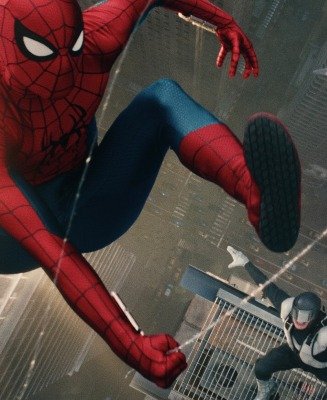
In the trailer’s opening action sequence, Peter Parker is swinging through New York streets while being shot at by militarized vehicles. The sequence is kinetic, impressive, and immediately establishes the street-level tone that Brand New Day is committed to. Then Jon Bernthal’s Frank Castle appears at the wheel of his battle van.
Peter gets hit by the van. Frank drives it directly into him.
Every site that covered this moment called it funny. Frank runs him down, they said. Peter gets knocked around, they said. Classic Spider-Man physical comedy, they said.
None of them asked the question that should have been the first question anyone asked.
How does a van hit Spider-Man?
Peter Parker’s spider-sense has never, in any version of his MCU story, failed to warn him about an incoming physical threat at close range. It is precognitive. It gives him awareness of danger before his conscious mind can register it. A van driven directly at him in an open street is exactly the kind of threat that his spider-sense exists to prevent. He should have moved before Frank ever got close enough to connect.
He did not move.
After the hit, Peter’s own reaction confirms it. He does not sound surprised that Frank is there. He sounds surprised that he got hit. “What the hell, Frank, you just hit me with a van,” he says. The emphasis in that line is not on Frank’s identity. It is on the fact that the hit connected.
That is a Spider-Man whose spider-sense is failing. And it is failing in the exact way the Man Spider transformation causes it to fail.
In the comics, as the mutation advances toward Man Spider, the finely calibrated early-warning system that Peter relies on does not disappear cleanly. It degrades and transforms. The precise, tactical danger awareness that allows Peter to fight twenty opponents simultaneously begins to blur and despecify. It starts reorienting from warning-system to hunting-instinct. A spider does not have a spider-sense in the way Peter Parker does. A spider has raw environmental awareness tuned for predation, not defense.
The van hits Peter in the trailer’s opening minutes because his spider-sense is already in transition. The first cycle is already ending. The cocoon scene later in the trailer is not the beginning of the Man Spider arc. It is the visible moment of a transformation that started long before Peter was consciously aware of it.
Four years of isolation. Four years of pushing past every limit. Four years of the mutation running without any biological check on it because the people who might have noticed the change do not remember who he is.
By the time the trailer begins, Peter Parker is already in his second cycle. He just does not know it yet.
What Is Marvel Man Spider: The Full Background for Every MCU Fan
The Character No Live Action Film Has Touched Before
Man Spider is what happens when Peter Parker loses the biological argument he has been having with his own DNA since he was bitten by a radioactive spider at fifteen years old. The mutation that gave him his powers was never a finished product. It was a process. And processes in biology do not stop unless something stops them.
When the process wins, what remains is a creature that is more spider than man. Six to eight functioning limbs. A hardened exoskeleton. Natural web production from the body itself without any mechanical assistance. Amplified strength that goes beyond the street-level power Peter normally operates with. And the near-total loss of the rational, heroic consciousness that makes Spider-Man who he is.
Man Spider is not a villain you can defeat by being smarter or more prepared. He is a state that Peter falls into when the biological pressure exceeds what his humanity can contain. The horror of every Man Spider story is not the creature itself. It is the people who have to look at the creature and keep calling it by Peter’s name because they refuse to accept that he is gone.
The Comics Source That Brand New Day Is Adapting
The direct comics source for what the trailer is showing is “The Other,” a Marvel crossover event from 2005 in which Peter Parker died following a confrontation with a multiversal predator named Morlun, cocooned, and emerged fundamentally changed: organic webbing, night vision, biological stingers in his wrists, and a new relationship with the spider-totem mythology that underpins what he is at a spiritual level.
The cocoon in the Brand New Day trailer matches “The Other” precisely. Peter is shirtless, cocooned against the exterior of his apartment building, with no mechanical web shooters visible anywhere. When he falls from the cocoon, he catches himself with webbing fired from his bare wrists.
But there is a second comics source layered underneath it that is less discussed. In the 1994 “Shrieking” arc from Amazing Spider-Man, Peter Parker cocooned not because of a physical threat but because his emotional and psychological state collapsed past a critical point. He was alone. He had lost the people closest to him. His body made a decision his mind could not authorize.
Brand New Day’s Peter Parker has spent four years in that exact emotional state. According to the official Sony Pictures synopsis released alongside the trailer, he has been living “entirely alone, having voluntarily erased himself from the lives and memories of those he loves.” Four years of complete isolation. Four years of being the city’s protector without a single person who remembers why he started.
The Shrieking arc tells us that is a biological trigger, not just an emotional one. Brand New Day is combining both sources into something the MCU has never attempted before.
The No Way Home Setup That Everyone Forgot About
Four years before Brand New Day, Peter Parker spent the climax of Spider-Man No Way Home doing something that nobody in the subsequent discourse ever asked about biologically.
He developed and administered a cure designed to interact with and reverse mutations in the bodies of alternate universe Spider-Man villains. He did this while his own mutation was already running. He administered it while standing in the same physical space as two other versions of himself whose mutations had developed differently over decades, one of whom had already gone in the purely biological direction that Peter is now moving toward.
The mutation does not distinguish between the person administering the cure and the person receiving it. It responds to biological signals in its environment. What signals was Peter’s mutation receiving in that lab? What did it learn from proximity to Tobey Maguire’s Peter, whose organic webbing represented a path that Tom Holland’s mutation had never taken?
The Brand New Day trailer is set four years after those events. Four years is a long time for a biological process to respond to new information. The organic webbing is not a sudden development. It is the endpoint of a four-year response.
According to the official Sony synopsis, the film’s central tension is that “the pressure sparks a surprising physical evolution that threatens his existence.” The word surprising is doing a lot of work in that sentence. Peter is surprised by what is happening to him. But the audience should not be. The biological groundwork was laid in No Way Home, and the only thing that was ever going to happen to it was exactly this.
What the Fan Response Today Already Understands
On X, a post from fan account @MarvelExrth616 went viral within hours of the trailer dropping: “WE CALLED IT: Spider-Man Is Literally COCOONING in Brand New Day. Our organic webbing mutation theory just got CONFIRMED by the trailer clips. Peter shirtless, collapsed on the floor, covered in organic webbing/cocoon material in a destroyed room.”
That account called the organic webbing months before the trailer confirmed it, and the reaction to that post reflects the broader fan feeling: this is the Spider-Man story the comics community has been waiting for a live-action version to attempt.
On Instagram, when Zendaya appeared on Jimmy Kimmel Live in the days before the trailer and was asked whether she had seen the new film, she confirmed she had seen “a good amount of something” and added: “I feel very good about it.” She shut down every attempt to get specific details about the film’s content. That kind of deliberate vagueness from a lead cast member is the specific behavior of someone protecting a story turn that has not yet been publicly processed.
The mutation arc is that story turn. And based on the trailer, Zendaya’s confidence is warranted.
The Three-Cycle Thesis: What Peter Parker Becomes at the End
Here is the theory that belongs to nobody else yet, built entirely from what the trailer shows.
The mystery narrator tells you Peter is in his second cycle: vulnerable, between states, dangerous to himself and others. The Hand appear at the word “rebirth.” Bruce Banner tells Peter his DNA is mutating and it is enormously dangerous. And somewhere in the second act of this film, Peter Parker stops being the Spider-Man the MCU has spent fifteen years building and becomes something that the people around him cannot immediately recognize or reach.
That is the Man Spider act. And it is going to be unlike anything Marvel has put on screen before, because every previous MCU crisis was something Peter faced as himself. This one is something Peter faces as a creature that is losing itself.
But the narrator’s third cycle exists. The rebirth is in the structure. Whatever Peter Parker becomes when the cocoon breaks for the last time, it will not be the version of him that went in. It will be a Spider-Man who has stopped fighting the two halves of what he is and learned to contain them both.
The spider chose Peter Parker in a school science exhibit when he was fifteen. The mutation that choice triggered has been building toward this for fifty years of comics history and fifteen years of MCU storytelling.
Brand New Day is where it arrives.
Spider-Man Brand New Day opens exclusively in theaters on July 31, 2026.
Director: Destin Daniel Cretton
Written by: Chris McKenna and Erik Sommers
Cast: Tom Holland, Zendaya, Jacob Batalon, Mark Ruffalo, Jon Bernthal, Sadie Sink, Michael Mando, Marvin Jones II, Tramell Tillman
Official synopsis source: Sony Pictures press release, March 18, 2026
